The MSF has reached a major milestone in research development: our pre-clinical in vitro platform is now ready! But what does this all mean? We’re happy to break it down for you and use a simple analogy to help bring this to life.
A pre-clinical in vitro platform (meaning before clinical trials, in cells) is a place to test potential drugs that could work for Myhre. Sounds straightforward, right? Just start testing. But the key thing is that you have to create an environment where every single time, the conditions are the same, the things you’re testing all go through the same process, so that when we get the results, we know they are valid. This is where it’s good to think of a bakery as our platform.
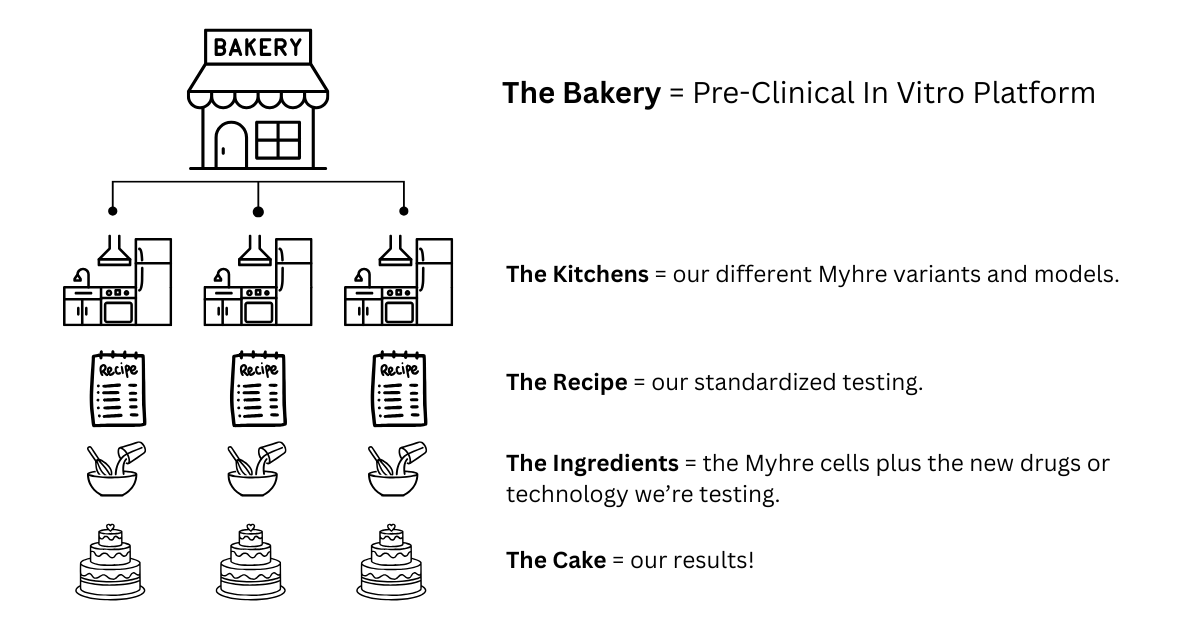
The Bakery = Our platform
The Kitchens = Our different Myhre cell models, representing different variants
The Recipe = Our standardized workflow about how drugs should be tested
The Ingredients = The Myhre cells and compounds (drugs) being tested
The Finished Cake = Our assay results (more on that below)
Our bakery isn’t set up to make just one type of cake. We have multiple kitchens, each with its own ingredients, each measuring something different about how the cells behave. What ties it all together is that every kitchen follows the same standards.
If you make one cake to see if the recipe works, you’re proving your concept works, but for a true platform, and to open the bakery, you need to be able to produce the same cake every day, with recipes and processes that other people who work there can follow. This consistency and reliability are what make it a platform.
Before we move on, we hear you ask - what is an assay?
The finished cake is what we measure, and this is called an assay. So when we look at the cake, we need to check whether it has risen properly, has the right texture, and tastes the way it should. In the platform, we measure how the Myhre cells are behaving, so that when something changes, we can spot it clearly. Think of this: before baking powder came along to give our cakes a little help with rising, the ingredients weren’t working as well as they could together. Adding that one tweak to make it all come together and make the best cake ever is what we’re trying to do with Myhre.
So we’ve got our bakery ready to open, now what?
We have set up the environment to make these standard cakes, which include all the ingredients important to us. We now want to ask other suppliers to bring their special ingredients to our bakery so that we can test them in our recipes. Because we have multiple kitchens running simultaneously, we can test more approaches at once.
And, we aren’t just open to traditional ingredients. Some of our suppliers coming to our bakery are bringing new types of ingredients, including technologies like gene editing. Rather than finding something that compensates for our current ingredients, this ingredient goes in and corrects them. Our bakery is set up to test that too.
We call it a ‘hit’ when we find a compound (drug) or technology that has a positive effect on our cells. So imagine a supplier arrives with the most amazing chocolate chips and dark cherries, which, when added to our cake, turn it into the best cake yet. Or another brings a new technology that corrects our ingredients at the source. Either way, we've found a hit!
So back in the lab, we’re now at the stage where we are inviting scientists to bring us their compounds, like suppliers bringing their new ingredients. With multiple kitchens and recipes running simultaneously, we are a step closer to finding a treatment that could make a real difference to people living with Myhre syndrome.
As with any great bakery that discovers new, soon-to-be best-selling recipes, these have to be kept under wraps while they are being developed. In science, it’s important to protect discoveries until the right moment, but rest assured, the bakery is open 24/7, and we promise to update you with anything we can share.
Quick Summary: Our platform is open, our kitchens are running, and we are actively testing compounds and technologies that could one day lead to a treatment for Myhre syndrome.
And a quick reminder on the research pipeline for context:
Basic Research → Pre-clinical In vitro (in patient cells & organoids) → Pre-clinical In vivo (animal models) → Clinical Trials (humans)
If you have any questions, please reach out to Armelle Pindon.